


Cryoberth Travel is a staple of most ‘harder’ science ficiton settings. In Traveller, insterstellar journeys by popsicle are looked on in-universe as the preserve of the destitute and desperate. The most common understanding of why low berths have such a low reputation, however, is perhaps misplaced. Allow me to elaborate…
Most canon designs for “adventure class starships,” the vessels below 1000 dTons that Player Characters will be operating for themselves or Travelling aboard, are equipped with between a half-dozen and a score of “Low Berths.”
One might then readily assume that the Low Berth is a Staple of Traveller play, seeing player characters selling trips by popsicle, and perhaps even choosing to forego a few weeks or months of watching Netflix, playing ping-pong with the wall, and eating the ship’s life support systems’ textured Kelp patties…in favor of a long, dark nap.
In spite of the Low Berth’s lower price, whenever anybody asks about Low Berths in Traveller, there’s a plurality of voices replying that find the Low Berth a laughable afterthought, the province only of the truly desperate.
Why is that?
Early editions of Traveller carried explicit text that ‘surviving the thawing process required a Medic roll’ from a technician. Furthermore, in early editions, the target number (TN) of the roll was always 7, with only Dice Modifiers (DMs) affecting the probability of success.
Hence if every low berth revival required a roll, the probability of survival in the hands of an average Tramp Freighter’s medic was merely 83%…or worse. From this assumption sprang a great deal of implied and explicit worldbuilding, that a ship carrying Low Passengers was effectively carrying one or more future corpses.
This worldbuilding even fed back in upon itself, and by the time I was learning about Traveller in the late ’90s by ways of the GURPS rendition of the setting, the idea of a gallows humor ‘lottery’ among a PC starship’s crew, placing bets on if all the Low Passengers would survive, was very nearly canon in the Original Traveller Universe.
(Opinion) this all started with a gross misunderstanding of the rules (or of the norms of Role-Playing Games).
You’ve probably heard a few maxims about when the GM ought to call for a die roll in a role-playing game. In some RPGs this question is rephrased into something different, like in Powered by the Apocalypse when a Player ‘triggers’ a move by doing the thing. In 2d20 system games, the game-master is asked to evaluate an attempted action based on ‘If it would be challenging for the protagonists of this genre.’ Nevertheless, there’s a central tendency of the maxims to say things like,
- “If the Player Character has the skill, they are competent. Only prompt a roll when their actions find them imperiled.
- “rolling for getting out of bed leads to a farce, turning a heroic or tense RPG into a game of personal misfortunes.
And the most commonly repeated maxim goes something like,
- “Only roll the dice if both success and failure are interesting.”
Now I’ll come out and say it: I don’t hold 100% to these ideas. In some systems, my reading of the rules tells me that the ‘task engine’ is also a ‘fiction generator’ that can plot some of the peaks and valleys of difficult days for the player characters. Margins of success and failure on a ‘routine’ difficulty level roll can sometimes tell a tale of how well things are under control, and in some dice engines can interject details about the ‘connective tissue’ between important moements of play.
Notwithstanding my own thoughts, which are very specifically grounded in systems that generate more data than pass/fail, there’s an even more compelling case that these assumptions about the Low Berth are misplaced.
The Gospel of ’70s Gaming
Tales are whispered of a time of yore, when outside of combat, players narrated the actions of their characters, and GMs interpreted those intents, narrating back the progression of events, even as difficultures arose. Nowhere were the dice to be seen during these conversations. It was only when a truly perilous moment arose, or the player reached beyond their assumed competence into feats of daring that the the GM required a “throw.”
(Hence the name, “Saving Throw”)
This Post unpacks the explicit language of 1977’s Black Book Traveller to suggest this was the assumed mode of play, that Traveller was Not a game with a ‘task system,’ but one with ‘Saving Throws.’
I think it’s a pretty compelling case, given that Travellers can spend 8-12 years in a profession, using a skill daily, and they can be lucky even then to emerge with a +1 DM to their skills. Having the Skill at all is the distinction in this paradigm, which then allows a character to attempt and complete any non-perilous tasks without resort to the dice.
Seems legit.
The exact same paragraph about “Saving Throws,” however, is likely the basis of the “Grim Reaper” rendition of Low Berths:
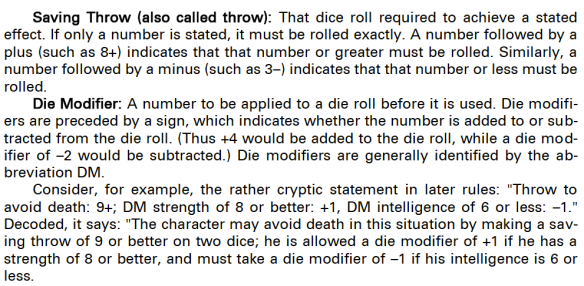
- “That Dice roll Required to Achieve a stated effect.”
- “that number or greater must be rolled”
Emphasis mine, But I feel pretty comfortable rendering the opposite accusation: that many folks picked up this manual, read ‘reviving lowberth passengers requires a medic roll,’ jumped to the fixed TN, then told the player to roll, because the Book says it right there: Required and Must. They might have been wrong to do that, but it’s clear they were doing it in droves, at least when it came to low berths, to the point it became a part of the game’s world, if not wholly canonized.
Notwithstanding, this conception of a Saving Throw over a Task system does suggest spheres of player and GM control, and that playesr have an envelope of control they’re acting within (in Traveller, it’s character competence).
And I don’t know about you, but I’m not keen on gambling with other human beings’ lives with those kinds of odds. It’s in my envelope of control to say ‘ill make my living another way.’ Likewise, as a GM, I’m not sure I want to Role-Play the kind of people that are in such desperate straits to roll dice with their lives simply to survive. It seems to communicate a universe with a lower regard for human life than far more grim RPGs like SLA Industries or Alien.

Regardless, the game was played this way for enough years by enough players that it has left its mark. Does it make sense? How can we re-conceptualize low berths within the setting to make sense? Once we step away from a mandatory roll for survival every time, how can we integrate the old lore of Cryoberth travel as risky and desperate move?
It’s inconsistent with the volume and the investments made in Low Berths
Beowulf free traders, the most ubiquitous short- and small-haul vessels come equipped with 20 low berths as standard. These workhorse vessels are described as both marginal and aspirational. against the pressures of instable freight volumes, the risks of piracy and other hazards, and uncooperative planetary governments, It can be hard to keep a Beowulf in good repair, its crew paid and making headway to pay off its mortgage.
And yet, rather than extra cargo or a faster maneuver drive that might increase her profitability, she devotes space and cost to bundling 20 low berths aboard. New Beowulf hulls are laid down in the year 1105 at shipyards across the imperial frontiers according to this template-
somebody thinks 20 low berths on a Beowulf is a good investment.
One could easily also read this as was a good investment, but conditions have changed. But with a free market and without dogmatic orthodoxies, the Third Imperium isnt’ the kind of place we’re given to think has held on to something stupid for centuries past its prime (unless there’s a specific someone that’s giving away stupid money…which is interesting to contemplate. See below.)
We are given to rationalize this in one of several ways:
- In some regions or circumstances, There is a reliable or lucrative volume of Low Berth Passengers. Filling the ship’s low berths can improve her margins and provide a steady baseline of income or occasional high-margin pickups. The ‘somebody’ is the future owner/operator of the ship. The 20 low berths represent a means toward either modest income and self-sustenance, or a latent opportunity. Either way, a plurality of Owner-Operators or the subsiders/guarantors of their loans think it’s a good investment.
- a reserve capacity of low berths provides valuable utility to intersellar governments, NGOs or megacorporations. Low berths and/or their maintenance are subsidized by these actors.
- incentives to the shipyard (tax breaks for installing a quota of low berths-like Mileage Per Gallon requirements for auto manufacturers are spread across different models in their lineup, the Beowulf becomes the ‘dumping ground’ for this capacity.
- low berth installation isn’t subsidized, but they’re maintained next-to-free-of-charge, perhaps by Traveller’s counterpart to the Red Cross, as a means of moving people in need of medical care to the systems where they can receive it. Maybe this is the ‘stupid money,’ and individual actors or government dysfunciton is at play for the glut of low berths, hanging like a millstone around the neck of the poor owner-operators of Beowulf free traders.
- the subsidizers/underwriters of the loans on Beowulf free traders mandate the ships have 20 low berths in order to qualify for the loan or tax break. Shipyards naturally oblige by shoving 20 low berths into the ship…this is another form of “stupid money” or governments and corportations pushing for a reserve oversupply.
It could be the case that the latter reason is dominant, in spite of a known high rate of lethality. Big actors are (or were, and then forgot what they were doing) looking to take advantage of folks with very little choice in the matter, either out of financial hardship or actual duress. Or maybe big actors are looking at a big picture, saving as many lives, hoping to turn casualty figures from wars and disasters from millions of deaths into tens of thousands.
But on the individual level, human beings are too loss-averse to accept the kinds of odds that ’77 Traveller mandates for low berth survival, if one toes the line roll every time for every passenger. Something smells smells off.
But let’s do an extended exploration here: what would it mean if there was an expectation only 83% of cryoberth passengers survived: and nevertheless the Cryochambers aboard Free Traders were full as often as not? What kind of human cargo would that be. Who would be paying…and who would stand to profit from that much death?
A Warrant for your Arrest…
What about people that don’t have a say? Like the incarcerated or enslaved? Well, 83% survival chances simply for riding the bus to jail (pre-trial even…) would certainly rate as ‘cruel and unusual’ punishment according to our own first-world ideas of human rights. Dire exigencies on the frontier of the Imperium might bend these rules. Maybe low berths are subsidized as a means of reducing the incentive to shoot wanted men dead in the street, and do defray local govenments incarcerating and executing prisoners out of convenience?
Bounty Hunting
It could be the case that there’s a raft of interstellar criminals, really ‘bad hombres’ that need to see justice before a central authority rather than doled out from the barrels of bounty hunter’s snub revolvers.
Getting the prisoner to trial for political theater purposes, and preserving the opportunities for interrogation and rehabilitation (if they have valuable skills) seems to work at cross-purposes to low berth travel.
Thus, if Bounties are a major component of Low Berth business, either the volume of bounties is so high that bounty hunters often opt to roll the dice toward ‘dead’ in ‘dead or alive’ as economically viable,
Or the bounty hunting market is so competitive that hunters are poaching bounties from each other before they have the security/ability to take bounties in alive,
Or bounty hunting is an amateur pastime, and Free Traders and their ilk are opportunistically taking on bounties themselves, but can’t risk keeping prisoners fed and under guard.
In all three cases, there’s a huge moral hazard leading to cases where the hunters are ambivalent to if they have the right person. Better to snatch the mark away from competitors…damn the torpedoes if a few innocents get swept up in the meantime. Are the spacelanes of the Imperial frontier really so unsafe for Travellers that they might be shanghaied at any moment?

Maybe it is this unsafe…but we also know that at least some Travellers enter play aspirationally, as Journalists, Scholars, or Idle Rich . This level of danger tells us that our wide-eyed new characters are in for a rude awakening to the rough-and-tumble frontier. The glamorous ‘wild west’ is a mere fantasy if this is so…The revelation of this reality (if the setting is run in this way) to the character would mark a major milestone of a Traveller’s time in play. Traveller Doesn’t have ‘Character Levels’ so it’s valuable to note turning points like this.
Sentenced to Transportation
The jails of 18th century England and Wales were rife with disease. The destitute found themselves incarcerated in ‘poor houses’ working off their debts in little better conditions. Driven to crime by poverty, ignorance, and (at least to some extent) a culture that romanticized the picaresque lives successful criminals like Tom Jones, men and women both found themselves sentenced instead to deportation to the far side of the world–Australia. The fate of this colonial project also meant the displacement and undoing of the indigenous people that already inhabited that Island continent. It was made possible by way of the British Empire’s preponderance of maritime and military power in the Global South. And yet, it began with shifting notions of human rights in the popular culture
Like the Britain of 1800 committed itself to ending the global slave trade, the Third Imperium makes membership and self-governance of member worlds contingent upon a basic observance of sentient’s rights. Like the British Empire, it’s also easy to imagine that those rules are frequently bent or broken in the name of greed. Interstellar Corporations might be ‘contracted’ by local systems to handle their prison system. Bankruptcy could mean deportation or exile on other worlds…facilitated with the help of Delgado Incorporated, that will help you begin your new life on an agricultural combine world…
So perhaps the ‘lethal’ low berths find their market from paying customers that are willing to pay a modest fee to ‘make a problem go away.’ …They won’t go so far as murder, but an 83% survival rate isn’t their problem any longer. This gets into very rough moral waters as planetary governments might use this as a tool for marginalization or purging undesirable factions.

IF the low berth is primarily an instrument of TRANSPORTATION, POGROMS, “PRIVATE PRISONS” and their ilk, the player-character Travellers become a privileged class, no longer subject to the whims of a world government, but invited to be instruments of the hypocritical system flying two points from the wind on ‘sentient’s rights.’ Which is interesting…a bit villainous for my tastes, and certainly a far cry from the scrappy and enterprising Space Truckers that make up the iconic bedrock of the game.
The Organ Grinders
What if the demand for low berths wasn’t a legal one at all? There was a grim time in Earth’s history when humans were sold into bondage, and it would be fortunate indeed if only 1/6th of the human cargo of a slave ship perished on the Transatlantic voyage. While Slavery is illegal within the Empire, the fact that we’re told this explicitly means that it’s likely a rule that is known in its breach as often as not. Could it be that human popsicles, warehoused upon sleazy tramp freighters skirting the boundaries of law, is really the personality of the Third Imperium?
We definitely have reason to believe that the more fly-by-night Tramp Ships that have ‘broken bad’ take on work like this, either in the employ of organized crime (perhaps turning a blind eye) or
Other possibilities
Let’s consider another possibility: maybe low berths aren’t just used for transporting people. Can they move livestock? Biomachines? The deceased, whose dying wish was to arrive home as more than a skeleton? Things start to get weird when one imagines the prospect of sliding into a chill bath of propylene glycol moments after Cow disembarked from the same pool. There are some references to Livestock in Low berth, and perhaps that’s the standard freight. If the cows die on the way, they turn into meat in the starport deli.
However, if meats, future meats and “biofactory” organisms made up the primary frieghtage in Low Berths, I think we’d hear about it. It is possible that this was a dominant cargo in the recent past, when the Traveller’s ships were laid down, but a shift in food culture across the Imperium or the rise of a new food production technology squashed the demand. Hundreds of thousands of Cryotubes across the Imperium were suddenly without a use-case, and have been hastily and haphazardly rebranded for human transport.
In this scenario, this new, cheaper form of travel has yet to gain a mature customer base, and may never get there if the survivability issues aren’t worked out. Take ‘new’ with a grain of salt here: Cryogenic Travel is millenia old in the Traveller universe, and might’ve been considerably more reliable in past eras. Centuries out of favor, the medical acumen, technical knowledge, and economic instruments necessary to make it profitable and safe haven’t yet been realized. If we imagine this to be the case, Low berths are a kind of ‘Wild Frontier’ of small Merchant Shipping. Yes, all of the above morally grim things can and are taking place aboard tramp ships, but it’s also a new avenue of enterprise, and the players are invited to be on the front line of the tense situation of human cargoes.
As social media apps like Twitter, Telegram, and Discord are used as command and control for protesters in unfree countries…and also as clandestine refuges for fascists, used as a venue for parody accounts…used as a replacement Play-By-Post Forum RPG play…We live in a time where new technologies and products come on the market with only the vaguest idea of what their use cases will be. It’s up to the users to discover them.
This is perhaps the most intriguing interpretation of the ‘unreliable low berth,’ the most interactive one as it invites players to improve the survival rate with their own efforts. It brings a sense of dynamism to the millenium-old Third Imperium and its economy that is often missing from the aesthetic of the Original Traveller Universe.
Back in 2021…
Mongoose Traveller 2nd edition sets up a robust paradigm for variable target numbers on a skill roll, each of which is named. The circumstances that allow a boon die, like assistance and good equipment, are known to both the players and the GM. Even if one rolled every time for Low Berth Revival, a routine roll, done while at a starport, with a crash cart at the ready and the Starport infirmary on Speed dial…we could easily be looking at TN 4 or 5 with a boon die.
After all, the operation is “routine,” right? (unless its not and mostly dead people travel in low berth to their funerals.) These odds start to improve enough that there’s lots of sane people in our universe that might be driven to use Cryoberth travel. Migrant workers. ‘On-Call’ gig workers, put on ice and sent to a general work area, where they can be dispatched and thawed to reach their next job. Destitute Families moving together to greener pastures, trying to save as much money as they can for the difficulties ahead in their new home. A person might opt for cryotravel to get the best medical care worlds away at a specialist cancer institute. A touring band might have a huge geographic gap in their itenerary, but a a block of gigs a sector or more away pulling them onward.
The human stories…of people on the counterpart of the Greyhound bus….this sounds like a much more rich canvas for roleplaying, eh?
and we needn’t rule out any of the above or change much about the Low Berth’s reputation…we can acknowledge simply that it is reliable, it does get used. …and yet, people fear it. Cryotravel is looked down upon and sneered at by high society as dangerous, risky, and the reserve of the desperate.
All of the above:
In a modern interpretation of the Third Imperium, drawing upon best practices from 45 years of the Roleplaying hobby regarding when to roll the dice and when to let it ride, and in consultation with Mongoose’s Splendid, Concise modernization of the Traveller of 1980, we can rationalize all the above guesses about a paradigm of ‘deadly low berths’ to inform a congruent imagining of a Third Imperium with “reliable” low berths.
- Low berths are reliable, when the thaw is initiated at a good starport.
- Thawing outside of the expected travel duration (early or late) might be more dangerous. The drug cocktail is administered specific to the duration of Travel, and with the patient’s metabolism on ‘pause,’ it’s hard to change that after the fact.
- Going into the Antifreeze bath means entrusting your life, limb, and kidneys to others. One might wake up in a slave labor camp beyond the Imperial frontier, or sold to a debauched noble for use in their secret hunting games…or harem. Holovid horror stories and folklore about nightmare scenarios like this run throughout the culture of the Third Imperium. And every so often, the stories turn out to be true.
- All kinds of agencies exist that are apt to pay for a Traveller’s Low berth fare…some out of largesse or charity, some as a means of recruiting a workforce, and still others with nefarious intentions.
- Brokerages exist allowing Tramp ships to place their Low Berths ‘on call,’ like Uber/Lyft, allowing Player Characters to ‘set and forget’ the low berths
- The act of Star Travel is romanticized in the culture of the Third Imperium. Many Player characters, after all, arrive at the table with a desire to turn Travelling into a full-time lifestyle. In cases where the choice between cryotravel and middle passage is under economic tension, many folks opt for middle passage simply out of a desire to experience for themselves an ‘elevated’ part of Imperial culture. Travelling by low berth is an opportunity cost: you could have shared nights with receptive strangers in your bunkroom, passed the days playing boardgames in the mess, and binge-watched your favorite holovids away from the world? Why wouldn’t you?
- Getting into a low berth means getting into a slushy bathtub that not long ago had a criminal in it…perhaps worse, a household pet or a farm animal. Of course, they clean the things…
- There’s possibilities for product differentiation, as different berths can be set aside for (men’s), (women’s), (pets), (the faithful of my religion…) After this many thousands of years, there may taboos about who can get
- “Do not use Low Berth Travel if you are nursing, pregnant, or may become pregnant…” arresting the metabolism might have serious consequences to fetal health. Likewise, the growth and maturation of the human body and mind might have risks.
- Waking up from a coma IRL, it’s sometimes reported folks feel like ‘they’ve returned a different person’ or their loved ones observe personality changes. In the far future of humanity, there’s probably drugs and therapies to recover from any post-cryberth psychoses, but that doesn’t make them any less undesirable.
- The world of psychoactive drugs and their users IRL tells us some folks are willing to risk losing their minds in order to arrive at a location…while others are less inclined. Cryotravel may be a matter of taste, and there’s lots of sneak previews available. Everyone has heard a story from a family member about the chill of the bath, the mask tight over their nose as the tranquilizers took hold…just as it’s as safe as a trip to the dentist, Cryotravel is at least as unpleasant as a trip to the dentist.

Traveller’s Low Berths are a fourth arm of enterprise for Player Starships to engage in. They’re another place where the ship can have a mundane, everyday business that runs itself in the background. They’re another place where commerce can turn into adventure, as the Traveller’s shout anxiously into their communicators, “Send Lawyers, Guns, and Money…”
![Resolute].png](https://complexgamesapologist.wordpress.com/wp-content/uploads/2018/10/resolute.png) Text: human species only. Increase your maximum stress by 3.
Text: human species only. Increase your maximum stress by 3.

 Talent Text: Trill Species only; GM permission required; once per mission, you may declare that a former host had expertise in a relevant field of study; you gain a single focus for the remainder of the scene. Additionally, you gain a trait, ‘symbiont,’ reflecting the potential advantages of joining the ability to perform rites and rituals to awaken past host’s memories…and vulnerabilities inherent in the condition. (Mutually incompatible with Former Initiate.)


 If you wish, treat this portion of the scene as a timed (gated) challenge “behind the screen.” Don’t show the players the interval track but do keep track of it, and perhaps prompt Momentum spends to reduce the time taken. (6 Intervals; when the last of the intervals expire add two to threat)


